"I’m currently planning the second 'informal chat' session on AI for my non-tech friends. These afternoon-long brunches started as me answering questions from people outside the technology field, following up with links and YouTube videos. This reflection is an attempt at scaling that knowledge-sharing approach for people who are not immersed in the tech industry—and an attempt to cut down on those delicious breakfast waffles."
What is AI and why is it suddenly “a thing”?
Oversimplifying, AI encompasses a computer’s ability to learn, solve problems, understand languages, and draw inferences. Similarly to how humans exhibit intelligence, AI makes computers seem intelligent and learn without being reprogrammed for every distinct variation.
Here are some practical examples of this in daily life with their fancy phrases for further reading:
- Fraud Detection & Machine Learning: You know how sometimes your bank decides that your purchase of an oversized Unicorn pool floatie at 3:00 AM in a random online store is fraudulent and declines your transaction? Blame that on machine learning models evaluating millions of past transactions. When your transaction resembles anomalous fraud patterns: no unicorn floatie for you. The similar floatie recommendations at the bottom of your feed are also machine learning at work.
- Google Photos Facial Vectors: Google Photos recognizes faces across thousands of pictures because it “learnt” to detect key features, geometric proportions, and recurring visual patterns.
- Natural Language Processing (NLP): Tools like Google Assistant, Alexa, or Siri employ NLP algorithms to decode conversational audio, disambiguate accents, and synthesize helpful responses.
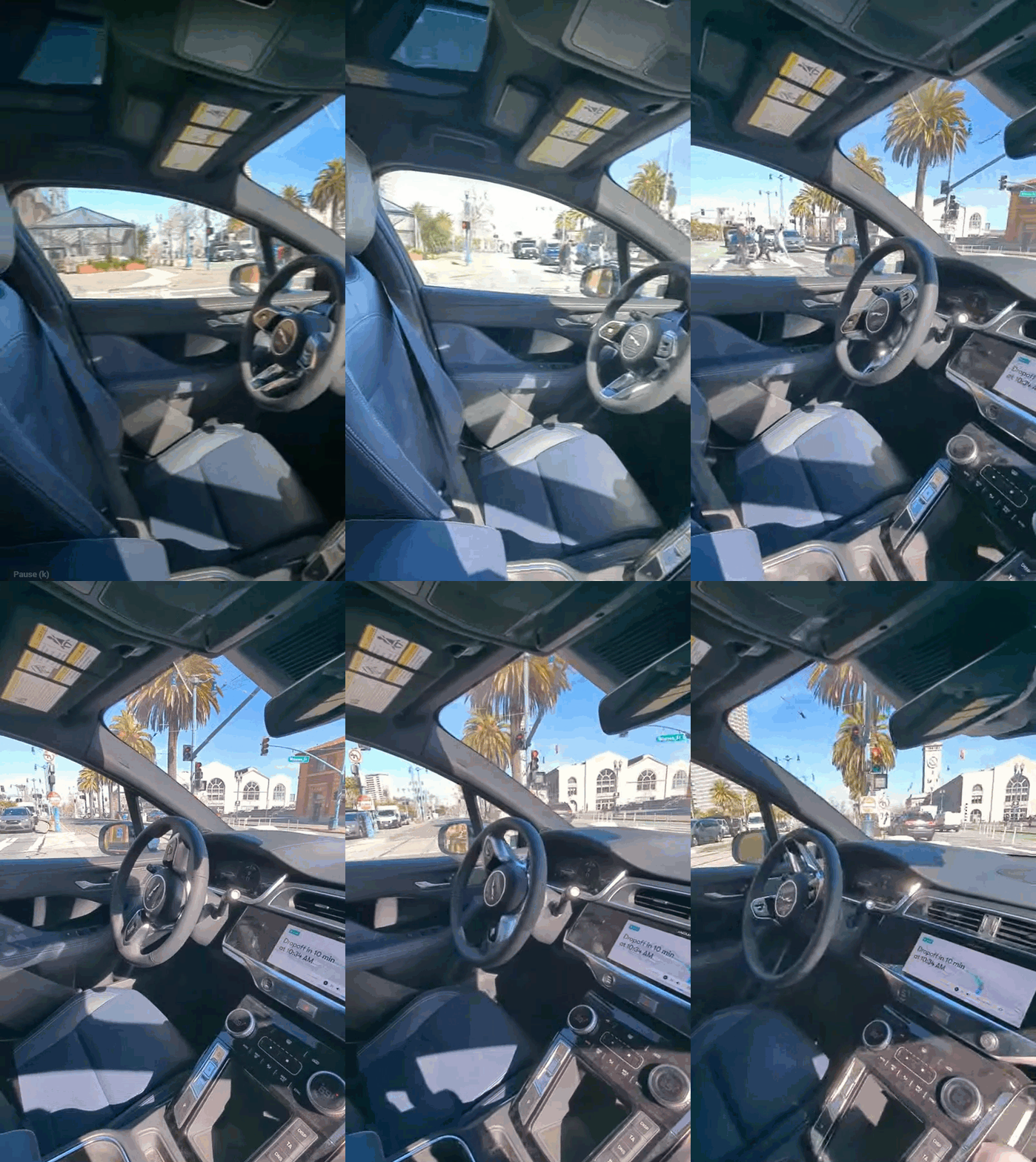
- Computer Vision & Deep Learning: Self-driving vehicles (like Waymo cars) require advanced scene comprehension (traffic lights, pedestrians, incoming traffic) and use Convolutional Neural Networks (CNNs).
✦ Self-Driving Vehicles: Deep learning & CNNs in real-world motion
How do I personally use Generative AI?
I’ve shortened this list to the non-confidential, practical uses of generative AI in my daily life:
- Refining Corporate Tone: As a bilingual engineer, when I need inspiration on communicating complex architectural points succinctly across global teams, I ask Gemini to suggest alternate framings.
- Rapid Data Exploration: Utilizing extensions like Simple ML for Sheets and BigQuery AI functions when processing ad-hoc datasets.
- Slide & Presentation Blueprints: Scaffolding visual slide layouts and structure outlines in Google Workspace.
- Everyday Exploration: Generating cat illustrations on Gemini, exploring trip itineraries with Perplexity.ai (which cites sources up front!), and experimenting with AI video workflows.
The Takeaway: Gen AI tools are here to accelerate productivity, not (yet ready) to replace critical thinking or human engineering judgment. And most importantly, always verify facts before relying on generated outputs!